
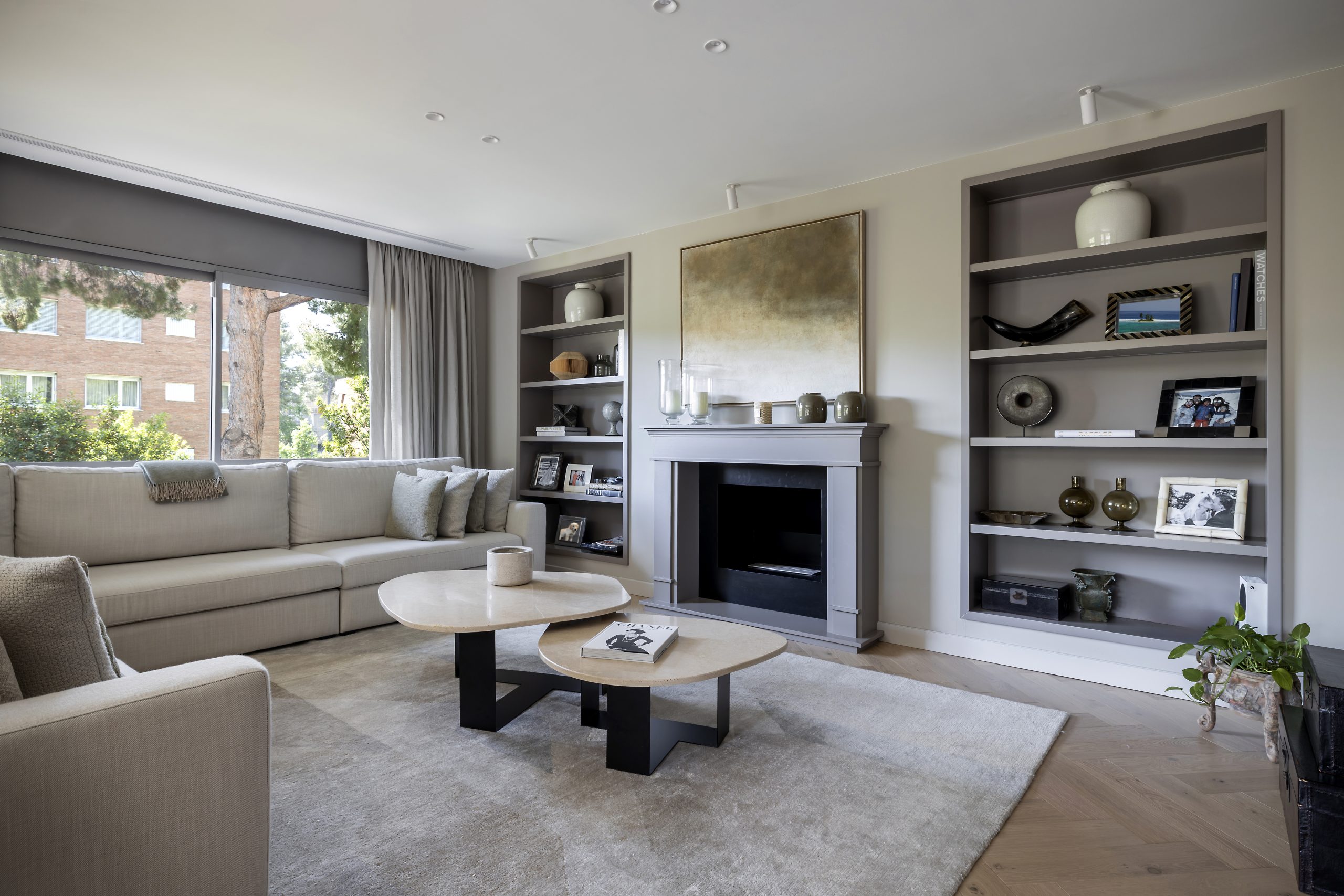
Luxury in architecture and interior design is not defined by price. It is defined by the absence of compromises. A luxurious interior is one in which every decision—regarding proportion, materials, lighting, and detail—has been made with the highest possible standards and executed with the precision necessary to ensure that those standards are maintained in the final result.
That can cost a lot of money. But spending a lot of money doesn’t guarantee that result. The difference lies in the criteria.
1. High standards as a starting point
A luxurious interior begins with an approach to the project, not with a budget. High standards apply even before choosing a material or a piece of furniture: they apply to the layout, the proportions, the relationship between spaces, and the quality of light. Everything else comes after.
Custom design from the very first decision
In a luxury interior, there are no standard solutions applied by default. Each space is designed from scratch: the dimensions of the openings, the ceiling heights, the placement of the windows, and the routing of the utilities. What in a conventional project is solved by referring to a catalog is solved here through custom design. It is this fundamental difference that determines the final result.
Consistency as an Invisible Luxury
One of the most distinctive features of a truly luxurious interior is its internal coherence. Nothing seems out of place, nothing appears to have been added as an afterthought, and nothing disrupts the flow of the space. This coherence is no accident: it is the result of a design process in which every decision is made within a single set of criteria, from the architecture down to the very last detail of execution.

2. Premium Materials: Authenticity and Durability
Materials are the most immediate expression of luxury in an interior. But not because they are expensive—rather, because they are authentic, because they have a character of their own, and because they are selected and arranged with a level of care that the eye perceives even if it cannot put it into words.
Natural stone: each piece is unique
Marble, travertine, limestone, and granite are materials that cannot be faithfully replicated. Each block has a one-of-a-kind grain, hue, and texture. In a luxury interior, natural stone is selected piece by piece; the grain is aligned at the joints; and it is installed with a precision that makes each surface unique. No ceramic tile, no matter how well crafted, can match this.
Solid wood and high-quality veneers
Wood in a luxury interior is not just a finish—it’s a presence. Well-treated solid wood flooring, veneer with a continuous grain, or solid wood millwork with invisible joints convey a quality that is perceived before you touch it and confirmed when you do. The natural aging of high-quality wood adds character over time rather than diminishing its value.
Metals: Detail and Precision
Metals—brass, bronze, stainless steel, nickel—appear in luxury interiors at touchpoints: handles, faucets, trim, and frames. They are small in size but make a big impact because the eye instinctively seeks them out. A well-designed solid brass handle says more about the quality of the project than any large-format surface.
3. The lighting: designed, not installed
In the interiors of luxury homes, lighting isn’t installed after construction is complete—it’s designed from the very beginning as part of the project. The difference between thoughtfully designed lighting and simply installed lighting is the difference between a space that has atmosphere and one that simply has light.
Natural Light as an Architectural Element
Luxury interiors treat natural light with the same care as any other structural material. The orientation of windows, the depth of eaves, the placement of skylights, and the relationship between interior and exterior spaces are all designed to ensure that natural light enters each space in the right way, at the right time, and with the right intensity.
Precision Artificial Lighting
Artificial lighting in a luxury interior is unobtrusive in its presence and precise in its effect. Recessed spotlights positioned with millimeter precision, hidden light strips that bathe a surface without revealing the source, custom-designed wall sconces, or designer lamps selected for their optical quality as well as their aesthetics: each light source has a specific purpose and a calculated effect on the space it illuminates.
4. The finer points of execution: where luxury is made or broken
An interior can feature the finest materials and excellent design yet lose all its value in the execution. It is in the details of execution that luxury is confirmed or disproved: in the joint between two materials, where the flooring meets the baseboard, in the precision with which a door fits into its frame, and in the flatness of a surface that must be perfect.
Skilled Trades
Luxury interiors require trades that are disappearing from the general market: cabinetmakers who work with solid wood with millimeter precision, plasterers capable of creating complex moldings, stone masons who align the grain in natural stone, and painters who apply special finishes with uniform results. Finding these professionals, coordinating them, and ensuring they meet the required standards is part of the design studio’s job.

Supervision as Part of the Service
A luxury interior design project does not end when the plans are delivered. It ends when the final detail of the execution has been resolved to the level of quality the project deserves. This requires continuous supervision of the construction site, with the ability to make decisions the moment a problem arises and the judgment necessary to resolve it without compromising the final result.
5. Outdoor Spaces: An Extension of the Interior
In luxury homes, the relationship between the interior and the exterior is not a transition—it is a continuity. Terraces, gardens, pools, and the transitional spaces between indoors and outdoors are designed with the same care as the interior spaces, using cohesive materials, well-considered proportions, and outdoor lighting that extends the home’s atmosphere beyond its walls.
Visual continuity between the interior and exterior
Flooring that flows from the interior to the exterior, water features that align with the horizontal lines of the architecture, walls that extend to define the outdoor space: these are the design choices that blur the boundary between inside and outside and create that sense of spaciousness and unity that characterizes the finest contemporary luxury homes.
At Ujo+Partners
We design high-end residential interiors where our high standards apply from the very first design decision to the very last detail of execution. If you’re planning a new home or a renovation where the result leaves no room for compromise, we can guide you through every phase of the process with the expertise and experience your project requires.


